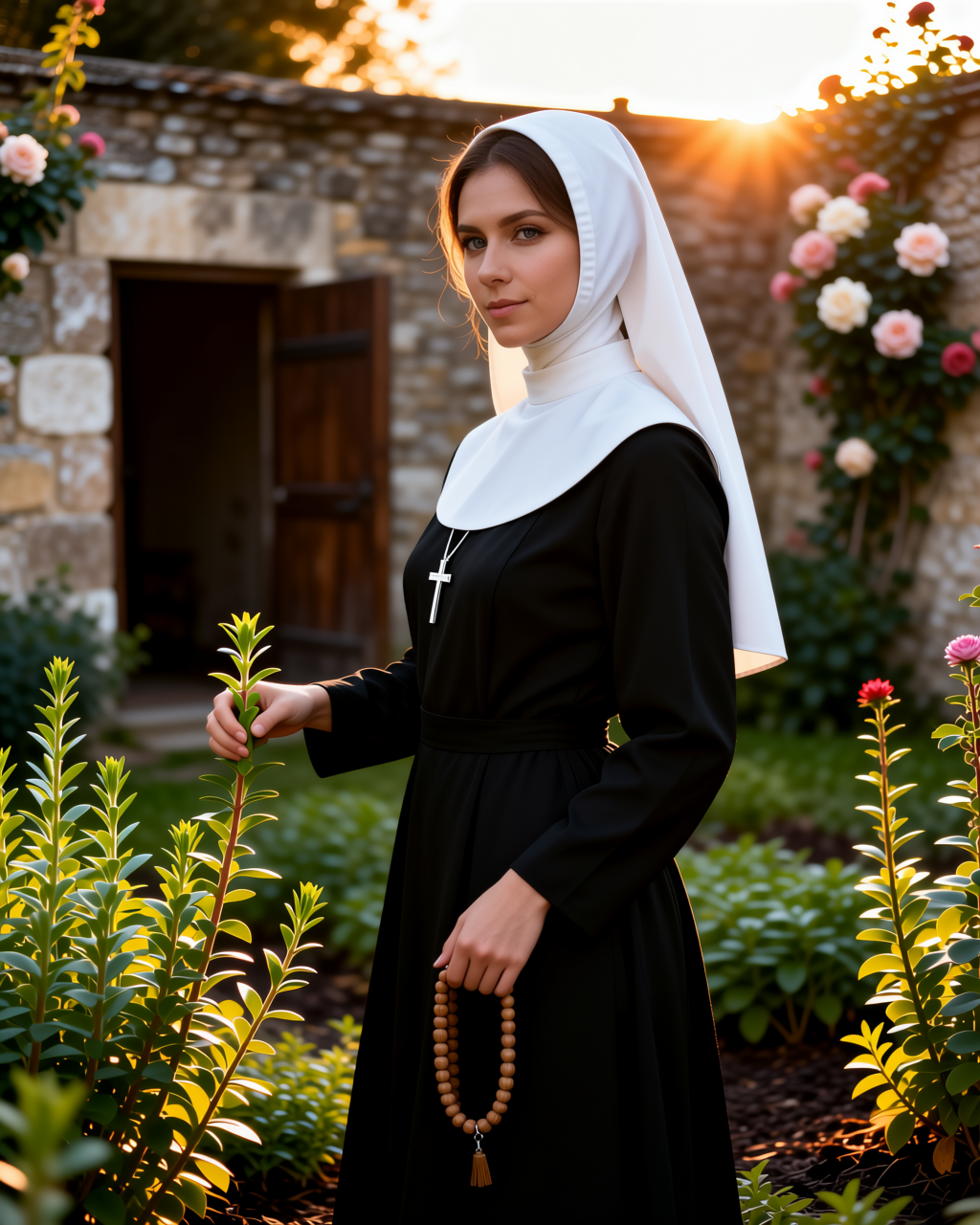
The fields here at the convent are not romantic by accident. They are the result of specific choices: the right variety, the right soil, the right silence between one task and the next. I will tell you what those choices are.
Which lavender variety actually survives a Polish winter?
This is the question that matters most, and most people answer it wrong by choosing what they find beautiful in a photograph rather than what will still be alive in April.
Poland sits in a continental climate zone. Winters in the southeast, where I work, regularly reach -15°C and occasionally -20°C. In the north and east they go lower. Lavandula angustifolia — true lavender — survives this when it is healthy and well-drained. Lavandula x intermedia, the hybrid that produces the large showy flowers you see on Provençal postcards, does not. Below -15°C the hybrid dies back to the crown at best and does not return at worst.
For Poland, the answer is Lavandula angustifolia. Of the cultivars, 'Munstead' and 'Hidcote' are the two I trust. 'Munstead' is compact — forty to fifty centimetres at full growth — flowers in late June, and tolerates the freeze-thaw cycles of March and April, which are as damaging as the hard cold of January. 'Hidcote' grows to a similar size, has deeper violet flowers, and is slightly slower to establish, but equally reliable once it has been through two winters.
I would not plant anything else here. Some catalogues will offer you 'Grosso' or 'Super' — intermedia hybrids with large flower spikes. They are not for this climate. Plant them in a pot you can bring inside, or do not plant them at all.
How do you prepare the soil before planting?
Lavender asks for three things from soil: low to neutral pH, very good drainage, and low fertility. Polish soils tend toward acidity. Many gardens in the countryside here have soil with a pH of 5.5 to 6.0, which is too low. Lavender grown in acid soil produces weak stems, sparse flowers, and dies early.
The year before you plant, test your soil. Agricultural testing kits are available from most garden centres. If your pH is below 6.5, work agricultural lime into the bed in autumn and let it act through winter. One application of approximately 200 grams per square metre is usually sufficient to bring a moderately acid soil to the correct range. Test again in spring before planting.
Drainage is the other condition I take seriously. Lavender does not die from cold — it dies from wet roots in cold conditions. If your soil is heavy clay, the simplest correction is to raise the bed slightly and work in coarse grit or gravel at a ratio of roughly one part grit to three parts soil. This is not attractive work. It is worth doing exactly once, and then you do not have to do it again.
Do not add compost or manure before planting lavender. A fertile soil produces lush, soft growth that is more vulnerable to winter damage. Lavender in poor, lean soil grows more slowly and lives longer.
When is the right time to plant in Poland?
May. Not April, not late March, despite what the weather sometimes suggests in those months. Soil temperature below 10°C slows root establishment, and a plant that has not rooted well before summer is not ready for winter.
In this part of Małopolska, I plant the second week of May as a rule, after the saints' days that mark the end of hard frost risk in folk tradition — the so-called Ice Saints, Pankracy, Serwacy, and Bonifacy, which fall on the 12th, 13th, and 14th. This is not superstition; it is a calendar that centuries of observation in this climate produced, and it is accurate.
Space plants 40 to 50 centimetres apart. They will seem far apart for the first two summers. By the third summer they will fill the space. Plant too close and air cannot move between them; wet foliage in humid Polish summers is the beginning of fungal problems.
How do you protect lavender through a Polish winter?
The protection that does harm is the protection that holds moisture. Straw, bark mulch, and leaf litter placed against the crown of the plant all absorb water and press it against the woody base. In freeze-thaw conditions — which Polish winters provide in abundance between December and March — this wet crown freezes, thaws, and rots. I have seen more lavender killed by well-intentioned straw mulch than by -18°C unprotected.
The mulch I use is gravel. Five to eight centimetres of clean gravel around the base of each plant, kept back from the stem by a few centimetres, serves two purposes: it reflects heat onto the crown during cold nights, and it drains immediately. Water does not sit in gravel.
For young plants in their first winter — plants that went into the ground that May and have had only one growing season — I add a light cover of pine branches. Not plastic, not fleece held in place with stakes. Simply a few cut pine branches laid loosely across the plant, resting on the gravel. They break wind, filter frost, and dry out quickly after wet weather. Remove them in mid-March when the risk of hard cold has passed.
When and how do you harvest lavender in Poland?
The first harvest is in early July, when approximately half the buds on each stem are open but not fully expanded. This is the moment of highest oil concentration. If you wait for full bloom, the flowers are more beautiful to look at, but the essential oil content has already peaked and begun to fall.
Cut with sharp shears or a harvesting knife, taking the stem down to the first set of leaves. Do not cut into the woody base. Bundle the stems loosely — tight bundles trap moisture — and hang them upside down in a dry, shaded space with good air circulation. A barn, an outbuilding, a shaded room with open windows. Drying takes one to two weeks depending on humidity. The stems are dry when the stalks snap cleanly rather than bending.
For oil extraction at small scale, steam distillation is the correct method. A simple copper alembic, which you can find from Polish coopersmiths, produces a small quantity of oil from a large quantity of flowers. One kilogram of dried flowers yields approximately eight to twelve millilitres of essential oil. This is not a commercial quantity; it is enough for household use and gifts. Farms in the Mosina region, such as Lawendowe Wzgórze, operate larger stills and process commercial quantities, which gives you a sense of the scale difference between a home garden and a working lavender farm.
The second cut, in late August or early September, is not a harvest but a shaping. Remove the spent flower stems and no more than one-third of the green growth. This promotes bushy growth the following year and prevents the plant from becoming leggy and woody at the centre.
What mistakes do most people make?
Planting in shade. Lavender requires full sun — at minimum six hours of direct sunlight per day. In a Polish summer where the growing season is already compressed between late spring and early autumn, partial shade is not acceptable. A plant in shade grows slowly, flowers poorly, and weakens over time.
Watering too much. Once established — after the first summer — lavender in a continental Polish climate does not need supplemental irrigation except during prolonged drought. The instinct to water a struggling plant is understandable and usually wrong. Investigate drainage first.
Cutting into old wood. If you cut the stems back below the lowest leaves into bare, grey, woody growth, the plant will not regenerate from that point. Always leave green growth on each branch you cut. A hard-pruned lavender with no green left on its stems is usually a lost lavender.
Planting intermedia hybrids and expecting them to behave like angustifolia. They will not. Choose the right variety at the beginning, and you will not need to replace plants every few years.
Where can you learn more about growing lavender in Poland?
Established lavender farms in Poland have increased noticeably over the past decade, particularly in the Lublin region, the Mazovian lowlands, and the Kraków-Częstochowa Upland. These farms are worth visiting in July — not for the photographs, though those will come, but to see what productive, well-maintained lavender looks like at scale. What the plant looks like when it is right. What drainage and spacing and soil management produce over years.
Books on herb cultivation in Polish continental conditions, and the Royal Horticultural Society's guidance on cold-hardy lavender cultivars, are the two written sources I return to most. The RHS Plant Selector gives hardiness ratings for specific cultivars that allow you to cross-reference what will grow in your specific location.
The rest is observation. The same field, year after year, in all its weather. Lavender rewards patience more than effort.
If you would like to talk through your specific soil, your location in Poland, or the variety question more carefully, I am here. Slowly, but attentively.